Consistent with new federal guidelines for private insurers, Cigna commercial will cover up to eight over-the-counter (OTC) diagnostic COVID-19 tests per month (per enrolled individual) with no out-of-pocket costs for the tests. This coverage began January 15, 2022 and continues through the end of the PHE (currently through April 15, 2022).
Please note that while Cigna Medicare Advantage plans do fully cover the costs for COVID-19 tests performed in a clinical setting, costs of at-home COVID-19 tests are not a covered benefit at this time.
Additionally, we encourage you to remind your patients that the Federal Government is now offering four free at-home test kits per household with no cost. Your patients can order the free at-home COVID-19 testing kits at COVIDtests.gov.
Coverage of COVID-19 treatments
As a reminder, Cigna commercial and Cigna Medicare Advantage cover FDA emergency use authorized (EUA) treatments of COVID-19, including monoclonal antibody treatments. This includes new antiviral medications PaxlovidTM and molnupiravir, as well as Remdesivir infusions when administered in an inpatient or outpatient setting.
Get all the most up-to-date information
We updated our dedicated COVID-19 provider web page on January 21, 2022 to highlight these updates more. You can also access the latest Cigna Medicare Advantage billing guidelines from this page. Please visit the site often to get the latest information.
NOT ALL HEALTH PLANS ARE RECOGNIZING THE NEW TELEHEALTH CODE
TMA staff recommend you check with health plans directly to find out if they recognize the following:
POS 10, a new Centers for Medicare & Medicaid Services code that corresponds to telehealth provided to patients at home, set to take effect on April 4.
Modifier 93, an American Medical Association CPT code modifier now in effect that corresponds with a real-time medical service delivered by telephone or another audio-only technology.
Also not yet recognized by all health plans are the following Healthcare Common Procedure Coding System modifiers:
Modifier FQ (furnished using audio-only communication technology);
Modifier FR (supervising practitioner was present through two-way communication technology with both audio and video); and
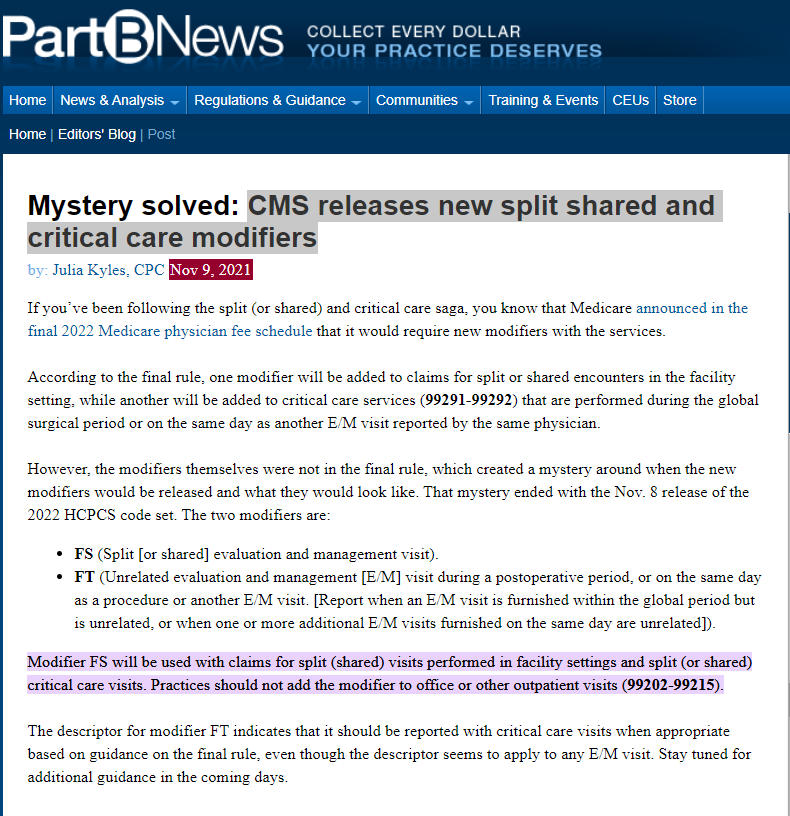
Modifier FT (unrelated evaluation and management during a postoperative period, or on the same day as a procedure or another evaluation and management visit).
TMA reimbursement specialists are keeping watch on insurers’ recognition of codes and modifiers. TMA’s Health Plan News page will post new developments as they emerge; for example, as noted on the Health Plan News page, Humana is recognizing modifier FQ.
Continue to read Texas Medicine Today for updates.
CPT copyright American Medical Association. All rights reserved.
On January 5th, Sir Seymore posted on Ink that POET is seeing a trend from Physician Offices that are trying to get a referral from Cigna MA.
Please scroll down to review that post for details.
POET received this information from Cigna MA: “Unfortunately, we’re experiencing a known enterprise-wide issue within the MHK/HSConnect platform that is affecting how many of our participating specialists are reflecting in the dropdown box or search box when attempting to generate a referral. The MHK/HSConnect team is working towards remediation but I have not yet heard when the expected date for completion might be.”
Just a reminder: SCPs do not need a referral due to the Public Health Emergency (PHE). The PHE has been extended until April 16, 2022.
PCPs and SCPs you are welcome to confirm participation with POET or Leslie.
Per Cigna MA, you should be able to manually enter the specialists’ (SCP) name/NPI for a referral.
Much of the federal government’s solution to resolve certain out-of-network billing disputes without balance billing or otherwise involving patients – known as the No Surprises Act – took effect at the start of 2022.
Among other pieces physicians must familiarize themselves with, the new federal law features an independent dispute resolution (IDR) process that was intended to let physicians and insurers both make their case for fair payment. Naturally, plenty of minutiae and arcana exists within the law, and a portion of the rules for the IDR process is under a legal challenge from the Texas Medical Association and others in organized medicine.
To help physician practices understand and navigate the new law, the American Medical Association has created a toolkit, Preparing for Implementation of the No Surprises Act. The 20-page toolkit includes information on:
Operational challenges physicians “will need to address immediately” to be compliant with the law’s new requirements, such as when uninsured and self-pay patients must receive a good-faith estimate of charges before they receive services;
What services and care fall under the rules of the No Surprises Act;
Timetables and requirements for the IDR process; and
When and how facilities and physician practices can obtain a patient’s consent to balance bill for out-of-network care at an in-network facility.
AMA says it will update the toolkit “as additional guidance is available” and will develop new resources on parts of the law not already included in the toolkit.
Meanwhile, TMA and others are still pushing to ensure the implementation of the law is fair for physicians seeking to get paid. In late October 2021, TMA filed suit to challenge what physicians and hospitals say is an unfair piece of the IDR process outlined in federal rules. Check future editions of Texas Medicine Today for updates on that lawsuit.
The Public Health Emergency (PHE) has been extended for the eight time.
The federal Department of Health and Human Services (HHS) has extended the COVID-19 public health emergency (PHE) for another 90 days, which means many payer flexibilities are likely to continue as well. HHS Secretary Xavier Becerra issued the extension on Jan. 14, two days before the PHE was set to expire. The new extension runs through April 16. It is the eighth extension of the PHE since HHS originally declared the emergency in late January 2020.
Beginning January 1, 2022 if a patient is UNINSURED or pays their own medical bills (if you don’t submit a claim to a health plan) the Provider MUST provide the patient with an estimate of expected charges BEFORE they provide the item or service.


Recent Comments