Tag: CMS (Medicare and Medicaid)
New Clinical Documentation Attachments Required for Prior Authorizations
Effective Jan. 1, 2026, the Centers for Medicare & Medicaid Services (CMS) requires prior authorization (PA) decisions within seven calendar days for standard (non-urgent) requests for medical items and services (See CMS Interoperability and Prior Authorization Final Rule – CMS-0057-F).
Below is From Humana
Humana is committed to maintaining the new streamlined time frame for PA decisions in accordance with this rule. To comply, all supporting clinical documentation must be submitted at the time of the PA request. Beginning May 16, 2026, providers submitting outpatient Medicare authorization requests for PA services via the Availity Essentials™ portal will be required to upload supporting clinical documentation. Exceptions may apply.
If you have other questions, please call 800-457-4708 (TTY: 711) Monday-Friday, 7 a.m. – 7 p.m., Eastern time.
CMS now requires impacted payers to send PA decisions to providers within 72 hours for expedited (urgent) requests and seven calendar days for standard (non-urgent) requests.
To streamline the PA process and comply with CMS Interoperability and Prior Authorization Final Rule – CMS-0057-F, supporting clinical documentation must be received with the authorization request. This ensures that Humana has the information necessary to promptly and accurately review requests.
This requirement applies to Medicare outpatient authorization requests for PA services submitted directly through Availity Essentials. It does not apply to home health services, inpatient services or Medicaid membership. This change does not impact submissions outside of Availity Essentials.
Availity Essentials will require clinical records to be attached before submission for outpatient PA services. If records are unavailable, your progress will be saved as a draft in the Authorization/Referral dashboard for up to 90 days. You may resume and submit once documentation is available. Please note, draft entries are not considered submissions; Humana will not receive your request until it is submitted with records attached.
Required information may include, but is not limited to, the items below:
• Patient details: Full name, date of birth and Humana policy ID number
• Referring and servicing provider details: Name, National Provider Identifier (NPI), Tax Identification Number (TIN), specialty and contact information (including fax)
• Diagnosis and procedure codes: Accurate International Classification of Diseases (ICD) diagnosis codes (up to six) and procedure codes (up to 10, as applicable) specific to the request
• Treatment details: Specific service, procedure, item or medication being requested, including planned date of service, service location, inpatient or outpatient status, quantity, medication dosage, frequency and duration
• Clinical rationale: Detailed explanation of medical necessity with supporting evidence from medical records. See Humana.com/CoveragePolicies for more information on clinical guidelines.
• Relevant medical history: Past medical conditions, current medications, allergies and significant laboratory results
• Supporting documentation: Imaging studies, laboratory reports, prior treatments or therapies, progress notes or other relevant clinical data that supports the medical necessity of the request
For additional details, please refer to the CMS Interoperability and Prior Authorization Final Rule – CMS0057-F and Humana coverage policies at Humana.com/CoveragePolicies.
Modifier 25 Gets Slashed Again!

Is it October Already? Isn’t it to early for Horror stories?
I think you will find this one pretty chilling,
none the less.
Centers for Medicare and Medicaid Services (CMS) proposes to slash doctors’ payment when they bill an office/outpatient evalutation and management (E/M) service using modifier 25 on the same day as certain global procedures.
While being touted as a measure to reduce health care costs, Texas Medical Association President Bradford W. Holland, MD, warns the proposed change could create a perverse incentive under which patients who could have been treated in one visit end up having to be treated in two visits, a move he calls “unacceptable for patient care.”
Texas physicians routinely diagnose and treat patients in a single visit to avoid unnecessary care delays, and “if this modifier 25 policy is ultimately adopted, we are deeply concerned about the potential impact on patient access to timely care,” he said.
To Grasp the HORROR of it all,
Follow the Below links.
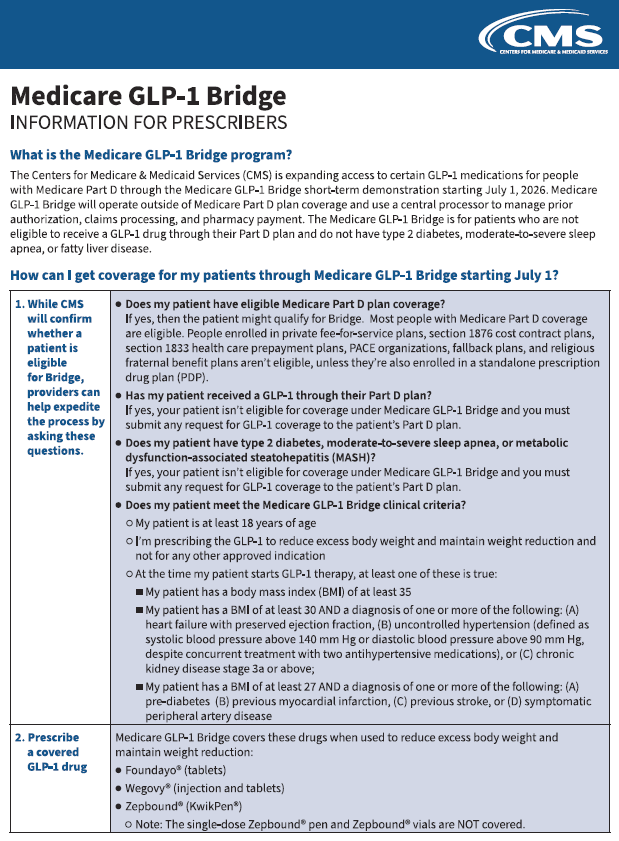
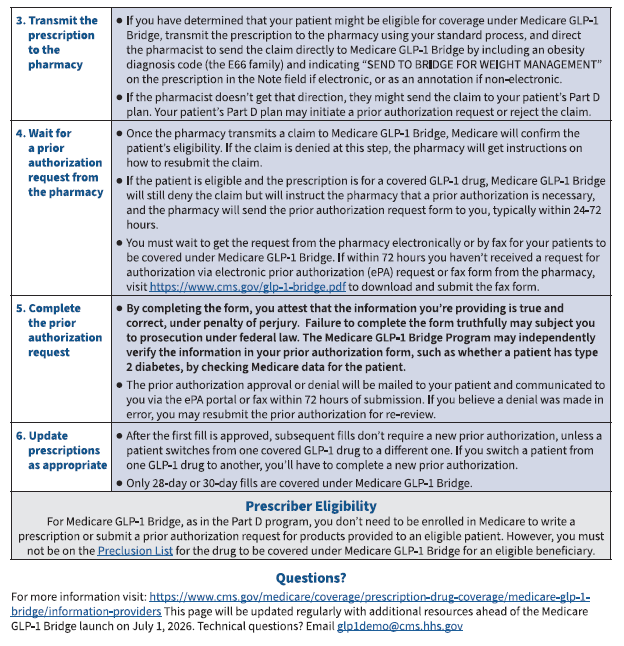
Medicare GLP-1 Bridge
Centers for Medicare & Medicaid Services (CMS)
Information for Prescribers
Superior Providers Have You RSVPed?

Join Us This Friday at the Affinity Center
If you have not RSVP’ed, please do.
This is your chance to visit face to face with Superior personnel.
Must be a Superior Provider through the POET Contract.

The POET office will be closed Friday from 10:15 a.m. to 2:00 p.m.
as staff prepare for and attend the Superior Meet & Greet.
If an urgent matter arises during this time, please call the POET Office.
Complete Your Medicaid Revalidation to Avoid Disenrollment
Texas physicians with Medicaid revalidation applications currently being processed, with deadlines on or before May 31, will be granted extensions ranging from 60 to 180 days, per the Texas Medicaid & Healthcare Partnership (TMHP).
TMHP offers the following online guidance:
- A physician who has not received a previous extension, and has a revalidation due date on or before May 31 is eligible for a first-time revalidation extension of 180 calendar days once the application is submitted (which TMHP labels “in-flight”); and
- A physician with an in-flight revalidation application already submitted and a due date on or before May 31, is eligible for a second extension of 180 days and a third extension of 60 days, plus additional 60-day extensions beyond the third.
The Texas Medical Association advises applicants who haven’t started revalidation yet to check due dates in the Provider Enrollment and Management System (PEMS), and especially if the due date is within 180 days, to fill and send their application promptly.
Also, physicians should note that a draft of an application saved in PEMS is not considered in-flight; it must be completed and submitted to gain in-flight status and thus the second and third extensions. Revalidation is not complete until an applicant’s revalidation request shows it is in “closed-enrolled” status.
Any extensions granted will be reflected in the “revalidation due dates” column on the Provider Information page of PEMS, TMHP says.
Physicians will also receive an email notification confirming their new revalidation due date once an extension is issued.
TMHP grants 165 cumulative business days to address all deficiencies on a revalidation application. If the revalidation application has unresolved issues taking it beyond that window, TMHP will close the application, requiring the physician to submit a new revalidation request.
Through its Physician Payment Resource Center, TMA offers help to physicians unfamiliar with the process or who have specific questions about using PEMS.
Last Updated On:
June 08, 2026
Originally Published On:
April 23, 2026
Final 2026 Medicare Conversion Factors: What Providers Need to Know
Understanding the difference between QP and non-QP conversion factors
Each year, the Centers for Medicare & Medicaid Services (CMS) finalizes updates that impact Medicare reimbursement under the Physician Fee Schedule (PFS). One of the most important updates is the Medicare Conversion Factor (CF) — the dollar amount used to convert Relative Value Units (RVUs) into the final payment amount.
For Calendar Year (CY) 2026, CMS finalized two separate conversion factors:
One for Qualifying Participants (QPs) in Advanced Alternative Payment Models (Advanced APMs)
One for Non-Qualifying Participants (Non-QPs)
This distinction is important because it directly affects reimbursement rates depending on a provider’s participation status in the Quality Payment Program (QPP).
Qualifying Participants (QPs)
A provider becomes a QP by meeting specific thresholds for participation in Advanced APMs, such as having a certain percentage of payments or patients through eligible Advanced APM arrangements.
Key point: QPs receive a more favorable conversion factor update than non-QPs.
Non-Qualifying Participants (Non-QPs)
Providers who do not meet QP thresholds—or who participate in MIPS instead—fall into the non-QP category.
Bottom Line:
The Final 2026 Medicare Conversion Factors reinforce a major policy direction: CMS continues to differentiate payment updates based on participation in Advanced APMs.
Understanding whether your clinicians are QPs or non-QPs is essential for accurate reimbursement forecasting and strategic planning.
Conversion Factor:
- $33.57 for qualifying alternative payment model (APM) participants (QPs)
- $33.40 for non-QPs
- An increase of 3.77% for QPs and 3.26% for non-QPs over the 2025 rates
- Includes 0.75% increase for QPs and 0.25 for non-QPs
- 0.49% positive budget neutrality adjustment
- 2.50% increase from the OBBBA for 2026
HealthSpring Provider Manual 2026
Have you received your copy of the HealthSpring Provider Manual?
The Definition of G0136 is Changing
Another Great Article from CodingIntel
November 2025
|
Medicare Beneficiaries Involved in CMS Data Breach
CMS Notifies Individuals Potentially Impacted by Data Incident
Approximately 103,000 beneficiaries may have been impacted.
POET has been told by several offices, they are seeing beneficiaries who have been assigned a new number by CMS.
CMS Instructs MACs to Lift Claims Hold

Special edition – courtesy of Novitas Solutions
Claims Hold Update
CMS instructed all Medicare Administrative Contractors (MACs) to lift the claims hold and process claims with dates of service of October 1, 2025, and later for certain services impacted by select expired Medicare legislative payment provisions passed under the Full-Year Continuing Appropriations and Extensions Act, 2025 (Pub. L. 119-4, Mar. 15, 2025). This includes claims paid under the Medicare Physician Fee Schedule, ground ambulance transport claims, and Federally Qualified Health Center (FQHC) claims. This includes telehealth claims that CMS can confirm are definitively for behavioral and mental health services. CMS has directed all MACs to continue to temporarily hold claims for other telehealth services (i.e. those that CMS cannot confirm are definitively for behavioral and mental health services) and for acute Hospital Care at Home claims.
Beginning October 1, 2025, for services that are not behavioral health services, many of the statutory limitations on payment for Medicare telehealth services that were, in response to the COVID-19 Public Health Emergency, lifted, and subsequently extended, through legislation again took effect. These include prohibition of many services provided to beneficiaries in their homes and outside of rural areas, and hospice recertifications that require a face-to-face encounter. In the absence of Congressional action, practitioners who choose to perform telehealth services that are not payable by Medicare on or after October 1, 2025, may want to evaluate providing beneficiaries with an Advance Beneficiary Notice of Noncoverage (ABN). Further information on use of the ABN, including ABN forms and form instructions: https://www.cms.gov/medicare/forms-notices/beneficiary-notices-initiative/ffs-abn. Practitioners should monitor Congressional action and may choose to hold claims associated with telehealth services that are currently not payable by Medicare in the absence of Congressional action. For further information: https://www.cms.gov/medicare/coverage/telehealth.
CMS notes that the Bipartisan Budget Act of 2018 (Pub. L. 115-123, Feb. 9, 2018), which added section 1899(l) to the Social Security Act, allows clinicians in applicable Medicare Shared Savings Program Accountable Care Organizations (ACOs) to provide and receive payment for covered telehealth services to certain Medicare beneficiaries without geographic restrictions and in the beneficiary’s home. Separate from requirements to participate in the Medicare Shared Savings Program, there is no special application or approval process for applicable ACOs or their ACO participants or ACO providers/suppliers to offer these covered telehealth services. Clinicians in applicable ACOs can furnish and receive payment for covered telehealth services under these special telehealth flexibilities. For clinicians in applicable ACOs, telehealth claims that CMS can confirm are definitively for behavioral and mental health services will be paid. At this time, claims for some telehealth services will continue to be held. For more information, including information on to which ACOs these flexibilities apply: https://www.cms.gov/files/document/shared-savings-program-telehealth-fact-sheet.pdf.
Recent Comments