





Time Change

Time Changes this week-end.

HSConnect is Integrating 10/30/2020

And the great news is, you don't have to do anything. Your Log-In and Password will remain the same.

Staff Salary Survey 2020: Staffing Trends

ADA Compliance & Translation Services

On 10/14/2020, This question was posed to MGMA regarding Translation Services.

I’m aware of the requirement to provide translation services for patients in compliance with ADA Title III, but I would like to know definitively whether translation apps such as Google Translate can meet the requirement in some scenarios, or if we must continue to use certified healthcare interpreters.  Can anyone point me in the right direction for either written guidance or an official opinion on this?

Matt Devino, Associate Director, Government Affairs MGMA, Washington DC, responds.

Thanks for posting this question. For people who are deaf or have a hearing disability, federal law requires providing a “qualified” interpreter. For the written guidance, please take a look at the Americans with Disabilities Act regulations at 28 CFR 36.303; 36.104 and Section 1557 regulations at 45 CFR 92.102. These regulations do not require that interpretation services be certified; instead, the legal standard is intended to be more flexible. While this offers greater latitude for group practices to select appropriate services, what “qualified” actually entails may be hazy in some cases.

Applicable regulations state that qualified “means an interpreter who, via a video remote interpreting (VRI) service or an on-site appearance, is able to interpret effectively, accurately, and impartially, both receptively and expressively, using any necessary specialized vocabulary.” Remote interpretation services are permitted, including “videotext displays,” so long as they are qualified. See 45 CFR 92.102(a)(1)(i) and this ADA guidance for more information. There is no exhaustive list of what types of interpretation services meet this standard, which can make applying it difficult in practice.

A follow up question was posed on 10/15/2020


Thank you both for your inputs and references as well as the clarification that the ADA requirements are for the deaf or those with hearing disabilities. 

Your responses, however, makes me wonder about another requirement, if in fact it is one, for those who do not speak English.  Not speaking nor understanding English is obviously not a disability, but everyone I have consulted tells me we are “required” to provide translators for those who don’t speak English and I’m now wondering if it’s a requirement or a courtesy?  And if it’s a requirement, I would love to know the references for these too if you know them…or if someone else does.  Is it perhaps a requirement by CMS or our other payers?  Either way, thank you for your initial response and I would sincerely like to learn more about what options are available to deal with non-English speaking patients too.  Are these candidates for Google Translate or some other widely used app…?

Matt Devino, Associate Director, Government Affairs MGMA, Washington DC, again responds.

Thanks for posting this question. For people who are deaf or have a hearing disability, federal law requires providing a “qualified” interpreter. For the written guidance, please take a look at the Americans with Disabilities Act regulations at 28 CFR 36.303; 36.104 and Section 1557 regulations at 45 CFR 92.102. These regulations do not require that interpretation services be certified; instead, the legal standard is intended to be more flexible. While this offers greater latitude for group practices to select appropriate services, what “qualified” actually entails may be hazy in some cases.

Applicable regulations state that qualified “means an interpreter who, via a video remote interpreting (VRI) service or an on-site appearance, is able to interpret effectively, accurately, and impartially, both receptively and expressively, using any necessary specialized vocabulary.” Remote interpretation services are permitted, including “videotext displays,” so long as they are qualified. See 45 CFR 92.102(a)(1)(i) and this ADA guidance for more information. There is no exhaustive list of what types of interpretation services meet this standard, which can make applying it difficult in practice.

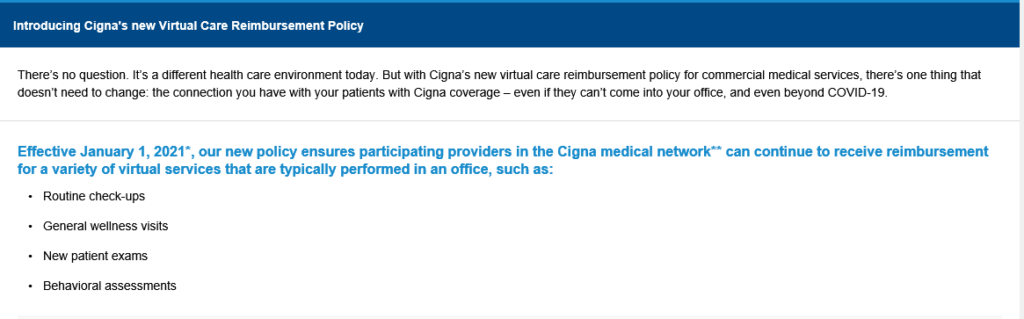
Introducing Cigna’s new Virtual Care Reimbursement Policy

View the full policy at CignaforHCP.com/virtualcare, or view our quick reference guide for a brief overview.

You Don’t have to Download.

DHS warns of Emotet

DHS warns that Emotet malware is one of the
most prevalent threats today (click to read the full article)

POET wanted to pass this on to you. It is an excellent article to use for ongoing security training.

Aetna Newsletter 10/1/2020

E/M Coding Changes are Coming. Effective 1/1/2021

AAP New Repayment Terms 10/12/2020
CMS released further information about the Medicare Accelerated and Advance Payment (AAP) program following the Continuing Resolution passage that revised the program’s repayment terms. Most notably, it appears CMS is automatically delaying recoupment for one year and will issue guidance on the recoupment process at a later date. The legislative text stated that CMS could delay payments “upon request” of the provider, and with this announcement, CMS will instead go further by automatically applying the delay to all recipients. From the announcement linked above:

Providers were required to make payments starting in August of this year, but with this action, repayment will be delayed until one year after payment was issued. After that first year, Medicare will automatically recoup 25 percent of Medicare payments otherwise owed to the provider or supplier for eleven months. At the end of the eleven-month period, recoupment will increase to 50 percent for another six months. If the provider or supplier is unable to repay the total amount of the AAP during this time-period (a total of 29 months), CMS will issue letters requiring repayment of any outstanding balance, subject to an interest rate of four percent.

Drew Voytal
Associate Director
MGMA Government Affairs
Washington, DC