BCBS Pharmacy Qtrly Updates for January 2026

Pharmacy Program Quarterly Update Changes Effective Jan. 1, 2026 – Part 1

Scheduling Webinar


“Every patient experience begins with the people who deliver care — and scheduling is what brings providers, nurses, and staff together at the right time. More than a staffing tool, scheduling is the backbone of modern healthcare.

In an era of workforce shortages, rising burnout, and increasing regulatory scrutiny, healthcare leaders are being called to go all in on strategies that unify scheduling, build workforce resilience, and seamlessly connect every member of the care team around the patient’s needs.

In this session, you’ll hear from a panel of healthcare innovators who have tackled the challenges of scheduling across providers, nurses, staff, and physical resources. They’ll share proven approaches you can apply to balance flexibility, fairness, and resilience while strengthening compliance confidence and improving visibility across your organization. You’ll leave with practical insights into how a holistic approach to scheduling can boost workforce engagement, improve access to care, and deliver stronger financial and patient outcomes.

Learning Objectives:

  • Recognize the schedule as a strategic asset for care team coordination, compliance, and patient access.
  • Learn how clinical and operations leaders can collaborate to unify scheduling, communication, and credentialing strategies.
  • Explore practical approaches to strengthening compliance confidence (e.g., EMTALA, ACS standards, audit requirements) through improved workforce coordination.
  • Recognize the enterprise value of going “all in” on workforce scheduling strategies to reduce risk, optimize resources, and improve patient and financial outcomes.”
Link to Register

The Definition of G0136 is Changing

Another Great Article from CodingIntel

November 2025

Dear Friends and Colleagues,

CMS is changing the definition of HCPCS code G0136. They are keeping the code and the valuation of the code. The code is staying on the telehealth list. But there is a completely new definition.
 
Between now and 12/31/2025, G0136 is for an assessment of a patient in the areas of social determinants of health (SDoH). On 1/1/2025, G0136 is defined as the assessment of physical activity and nutrition.
 
New definition
G0136 “Administration of a standardized, evidence-based assessment of physical activity and nutrition, 5-15 minutes, not more often than every 6 months.”

  • This service is not intended to be a screening for every patient. It is to be performed when there are known or suspected needs related to the patient’s physical activity level and nutrition.
  • The service is payable when both a physical activity and nutrition assessment are performed, “…or when either a physical activity or risk assessment is performed if there is a clinical scenario where only one is reasonable and necessary. For example, if a beneficiary has recently started a new diet but their physical activity levels have not been assessed, only a physical activity risk assessment may be reasonable and necessary.”
  • It can be billed at the same encounter as an E/M service, an annual wellness visit, 90791 psychiatric diagnostic evaluation, and health behavior assessment codes 96156, 96158, 96159, 96164, 96165, 96167, and 96168.  What about 90792? The final rule does not list it as one of the base codes for G0136.
  • When performed on the day of an annual wellness visit, there is no patient due amount. When performed on the day of any of the other visits listed, it will be subject to the deductible and co-pay.
  • There is a frequency limit of once per six months per practitioner per beneficiary. 

What’s required? In the definition, it says administration of a standardized evidence-based assessment. CMS is not requiring a specific assessment tool but gives examples of those tools. Those are listed below. Notice that it says 5 to 15 minutes. I would suggest documenting the time of the assessment, distinct from the other services. When time is listed in a CPT® or HCPCS code, document the time spent. I believe this assessment will be done by auxiliary staff, although how that is managed in the work flow when it is done after the practitioner assesses a need, I don’t know.
 
RHCs and FQHCs  G0136 may be performed in an RHC or an FQHC, but will not result in additional reimbursement when performed on the same day as another service. It is not considered a qualifying visit in an FQHC, so if it is the only service performed on that date of service, there is no reimbursement for it.
 
Examples of evidence-based tools to assess nutrition include, but are not limited to, the Mini-EAT tool, the Starting the Conversation: Diet tool, and Short Dietary Assessment Instruments. Examples of evidence-based tools to assess physical activity include, but are not limited to, the Physical Activity Vital Sign tool, the CHAMPS Physical Activity Questionnaire for Older Adults, and the Rapid Assessment of Physical Activity (RAPA) or Telephone Assessment of Physical Activity (TAPA).
 
CMS 2026 Physician Fee Schedule Final Rule, [CMS-1832-F]  Display copy, pp 459–465

Enjoy fall,
Betsy

CodingIntel by Betsy Nicoletti

BCBS CIR Cheat Sheet

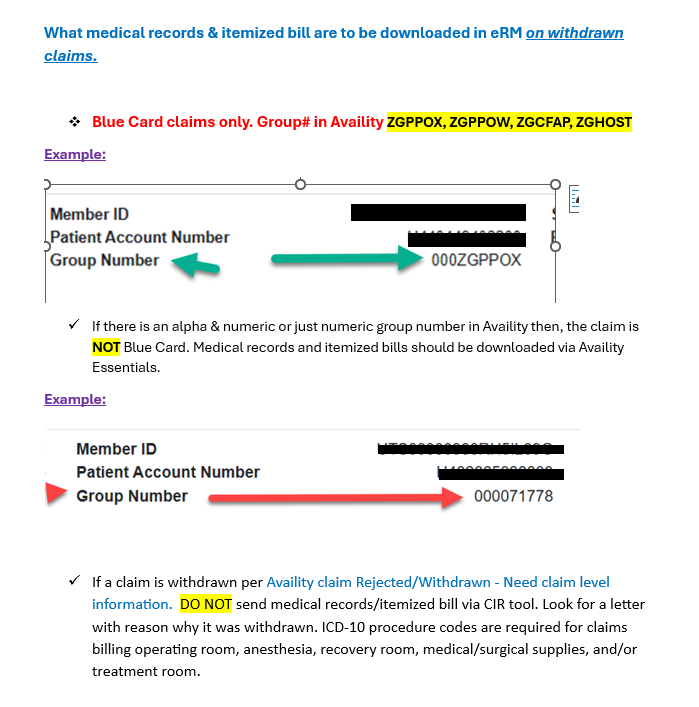
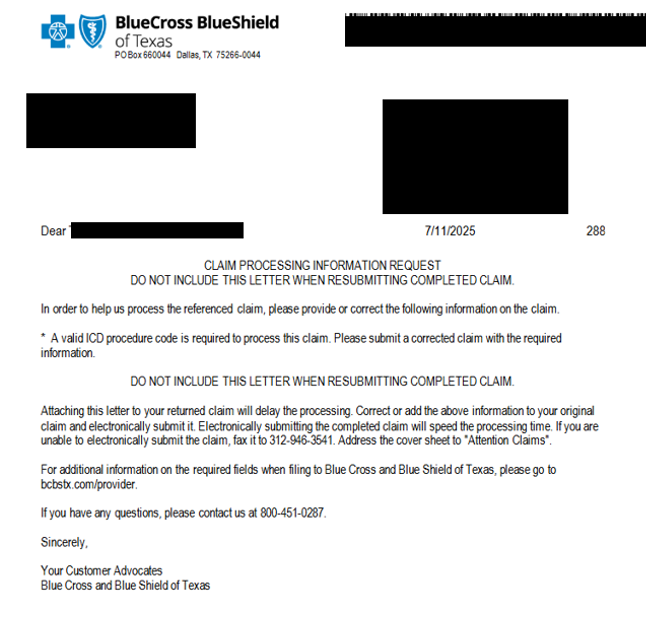
“The Claim Inquiry Resolution (CIR) tool within the Electronic Refund Management (eRM) portal accessed via Availity® Essentials only accepts inquiry submissions related to High-Dollar, Pre-Pay Review requests for most Host (BlueCard® out-of-area) claims (Medical Records and/or Itemized Bills). The other inquiry options that were available via CIR have transitioned to the Availity Claim Status Tool’s Dispute Claim or Message This Payer features.” Per BCBS Provider Education. 

WHAT CAN BE DOWNLOADED TO eRM?

See Example Below —

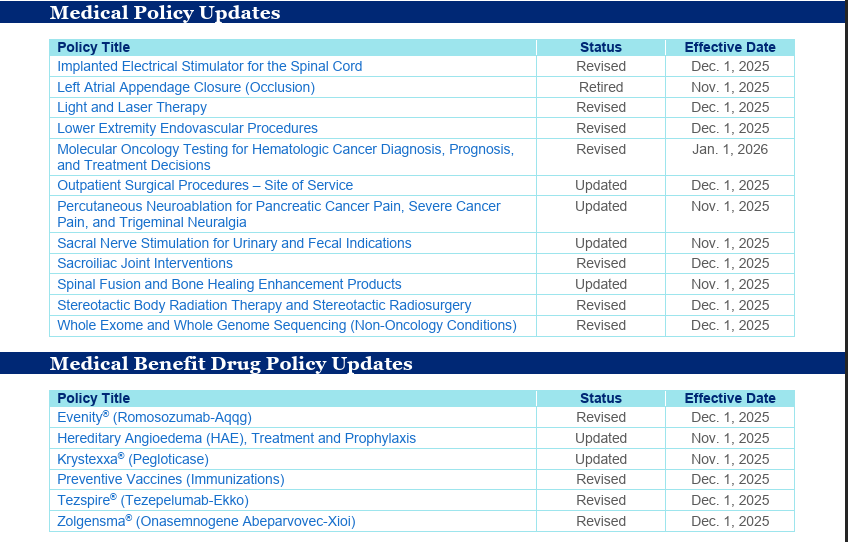
UHC November Update

A list of recently approved, revised, and/or retired Medical Policies and/or Medical Benefit Drug Policies is provided below for your reference. For a comprehensive summary of the latest updates, refer to the Medical Policy Update Bulletin: November 2025.