In health insurance, an EPO is an Exclusive Provider Organization plan.
Here’s what that means in practical terms:
What an EPO plan is
You must use doctors, hospitals, and facilities in the plan’s network 👉 Except for true emergencies
You do not need a referral to see a specialist
Care received outside the network is not covered at all (again, except emergencies)
Pros of an EPO
Usually lower monthly premiums than PPO plans
No primary care referral requirement
Simpler than HMO plans
Cons of an EPO
No out-of-network coverage
Limited flexibility if you travel a lot or want a specific doctor who isn’t in-network
How EPO compares to other plans
EPO vs PPO: PPO allows out-of-network care (at higher cost); EPO does not
EPO vs HMO: HMO usually requires referrals; EPO does not
Disclaimer: The information provided in this blog is for general educational purposes only. While Ink strives to explain insurance concepts accurately and clearly, payer rules, contracts, and policies can vary widely by plan, state, and provider agreement—and they change frequently.
This content should not be interpreted as definitive guidance or a substitute for reviewing payer manuals, contracts, or official communications. Physician offices are encouraged to conduct their own research and verify requirements directly with the applicable insurance carriers before making operational or billing decisions.
Interpreting insurance cards has never been easy, but with the constant changes in today’s insurance landscape, it has become nearly impossible.
Every week seems to bring a new insurance company—or anestablished insurer that has acquired several others, rebranded, and rewritten the rules.
On top of that, there are hybrid plans like POS and EPO, along with discount cards, medical cost-sharing programs, limited-benefit plans, and the growing model of Direct Primary Care.
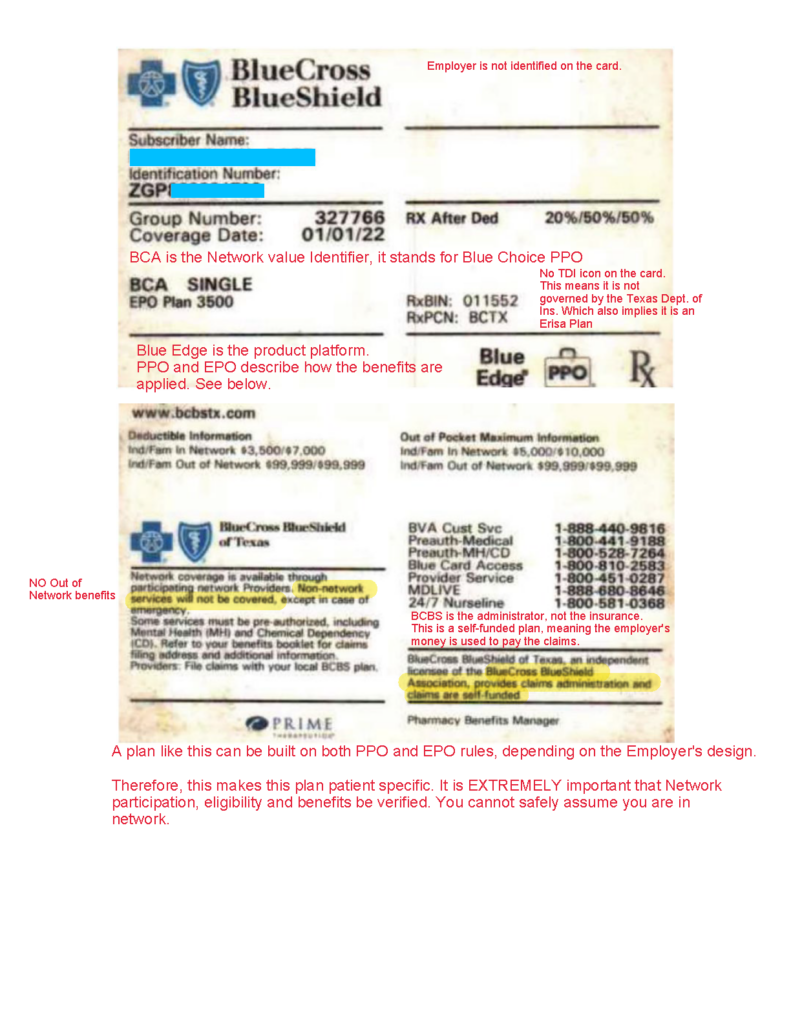
The one pictured below is an ultimate example!
It takes hybrid to a new level of complexity.
By mixing the rules of PPO and EPO in one plan.
Therefore, I, Sir Seymore, have taken my red pen in hand in an effort to make sense of it all.
Per CMS CLIA Communications Update: This is your last chance to go paperless before we eliminate paper fee coupons and CLIA Certificates on March 1, 2026. In addition, laboratories must pay their CLIA certification and survey fees online (checks will no longer be accepted). Failure to go paperless may result in billing or certification issues.
When you switch to paperless, your laboratory will get: • Email notifications from CMS • Electronic fee coupons* • Electronic CLIA certificate – no more waiting for it to come in the mail* *This does not apply to CLIA-exempt states or state licensure.
To switch, you must either: • Email your State Agency Tip: Include your laboratory name, laboratory director or owner’s name, CLIA number, director or designee’s signature to help your State Agency make the switch.
• Contact your Accreditation Organization (for accredited labs). They can add or update email addresses for the laboratories they survey.
Update: POET has been advised that the issue involving HealthSpring, CPL, and Polk County is related to a claims system error. HealthSpring has confirmed that they are currently in contract with CPL, and the issue is actively being worked on.
POET we keep you updated, as we receive information.
Recent Comments