Is it October Already? Isn’t it to early for Horror stories?
I think you will find this one pretty chilling,
none the less.
Centers for Medicare and Medicaid Services (CMS) proposes to slash doctors’ payment when they bill an office/outpatient evalutation and management (E/M) service using modifier 25 on the same day as certain global procedures.
While being touted as a measure to reduce health care costs, Texas Medical Association President Bradford W. Holland, MD, warns the proposed change could create a perverse incentive under which patients who could have been treated in one visit end up having to be treated in two visits, a move he calls “unacceptable for patient care.”
Texas physicians routinely diagnose and treat patients in a single visit to avoid unnecessary care delays, and “if this modifier 25 policy is ultimately adopted, we are deeply concerned about the potential impact on patient access to timely care,” he said.
YOU SHOULD ALWAYS CHECK NETWORK PARTICIPATION,
DO NOT SKIP THIS STEP.
Please read this article closely. It could save you time, money, and headaches.
What is an "H" number?
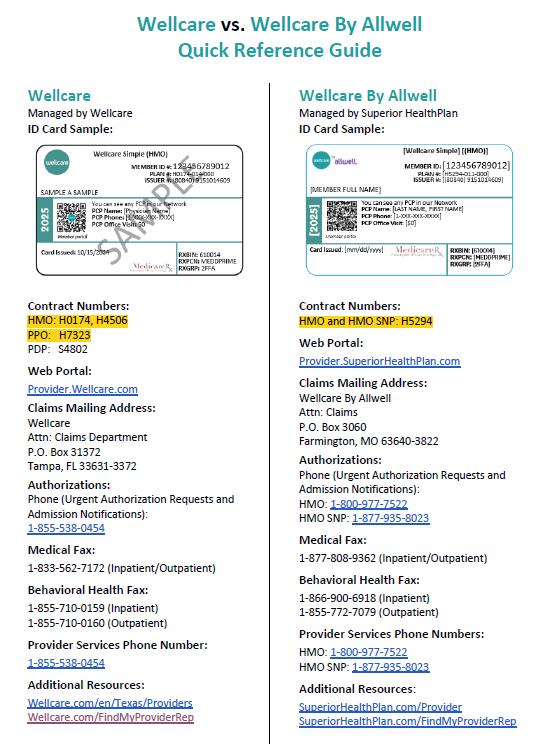
CMS assigns every Medicare Advantage organization a five-character contract number, sometimes called an H-code. That contract number represents the legal agreement between the insurance company and the federal government. A single insurer might hold several contract numbers. Not every contract number starts with “H.” CMS uses different letters for different plan types:
H: Local plans, including most HMOs and local PPOs
R: Regional PPO plans that cover a wider geographic area
S: Stand-alone prescription drug plans (Part D only)
E: Employer-sponsored Medicare Advantage and Part D plans
An "H" number on the card will look like this: H0609-060-000
When comparing Medicare Advantage plan ID cards, it’s important to compare apples to apples.
However, the 5 digit contract number alone is not always enough. For example:
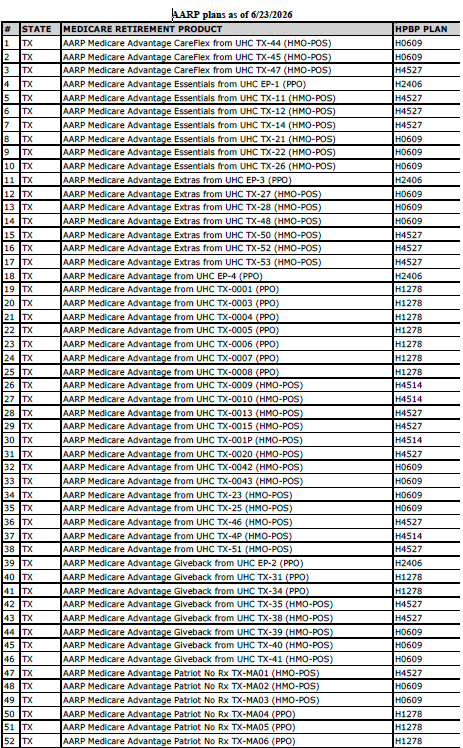
AARP Medicare Advantage CareFlex from UHC-44 (HMO-POS) has contract number H0609.
AARP Medicare Advantage Extras from UHC TX-27 (HMO-POS) also has contract number H0609.
Although these plans share the same contract number, they are different plans.
To accurately identify a member’s plan, compare the entire 11-character Plan ID, not just the H number. Using the full Plan ID helps ensure you are reviewing the correct plan and its associated benefits and network.
Please, Do Not Skip Verification
UHC disclaimer: Oxford Data refresh date: 06/16/2026, all other lines of business: 6/15/2026 To check your participation status with employer-specific plans, please contact your Advocate or Network Account Manager. CONFIDENTIALITY NOTICE: Information accompanying this facsimile is considered to be UnitedHealthcare’s confidential and/or proprietary business information. Consequently, this information may be used only by the person or entity to which it is addressed. Such recipient shall be liable for using and protecting UnitedHealthcare’s information from further disclosure or misuse, consistent with applicable contract and/or law. The information you have received may contain protected health information (PHI) and must be handled according to applicable state and federal laws, including, but not limited to HIPAA. Individuals who misuse such information may be subject to both civil and criminal penalties. If you believe you received this information in error, please contact the sender immediately.
If you would like this list in excel format, please contact POET office.
Remember these are Government Contracts and are subject to change.
And Don't Forget to Ask for Provider Participation
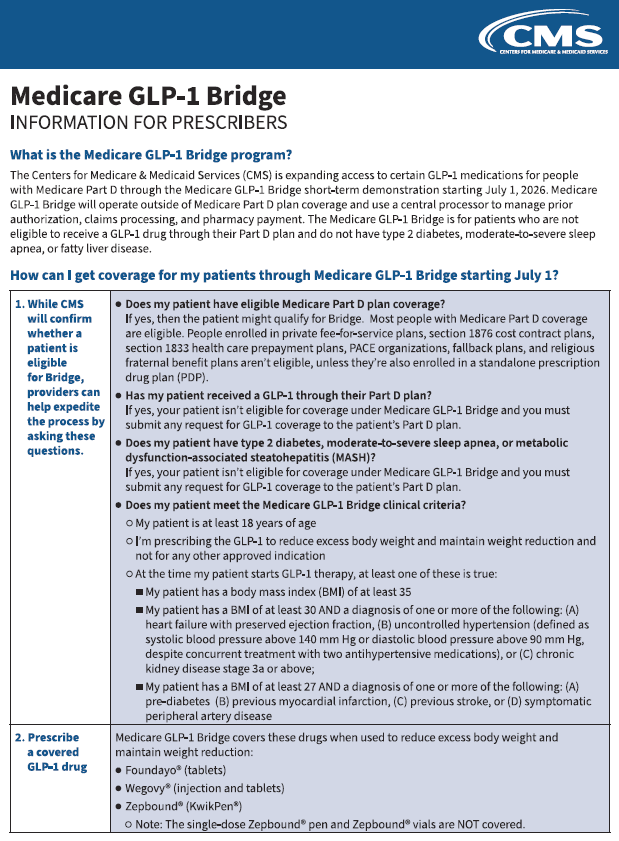
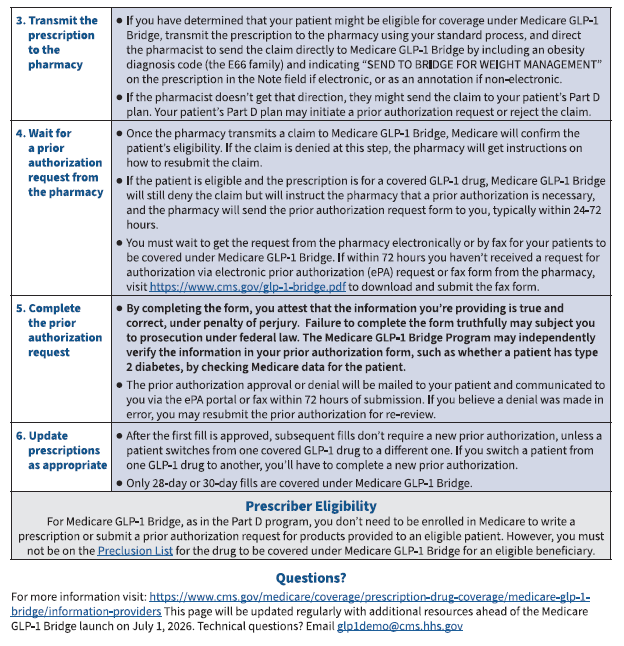
Eligible Medicare beneficiaries may now get certain GLP-1 medications for $50 per month through the Medicare GLP-1 Bridge, a new CMS initiative designed to expand access to innovative treatments and test the impacts of increased access to GLP-1 drugs for weight management on theMedicare program
We’re changing prior authorization requirements that may apply to some HealthSpring Medicare Advantage members.
Changes are based on updates from utilization management prior authorization assessment, Current Procedural Terminology (CPT®) code changes released by the American Medical Association or Healthcare Common Procedure Coding System code changes from the Centers for Medicare & Medicaid Services.
For some services and members, prior authorization may be required through HealthSpring utilization management, and related services for Medicare Advantage members will be reviewed by HealthSpring and EviCore healthcare.
These changes begin July 1, 2026:
· Implementation of Part B Step Therapy Program
· Addition of orthotic codes to be reviewed by HealthSpring
· Addition of new Medicare Advantage Prescription Drug plan codes to be reviewed by HealthSpring
For more information, refer to the prior authorization requirements list on the clinical review page.
Always check eligibility and benefits first through Availity® Essentials or your preferred vendor prior to rendering services. This step will confirm prior authorization requirements and utilization management vendors, if applicable.
Checking eligibility and/or benefit information and/or obtaining prior authorization is not a guarantee of payment. Benefits will be determined once a claim is received and will be based upon, among other things, the member’s eligibility, and the terms of the member’s evidence of coverage. If you have any questions, call the number on the member’s ID card.
Services performed without required prior authorization or that do not meet medical necessity criteria may be denied for payment, and the rendering provider may not seek reimbursement from the member.
Thank you for your partnership.
CPT copyright 2025 American Medical Association. All rights reserved. CPT is a registered trademark of the AMA.
HealthSpring products and services are provided exclusively by or through operating subsidiaries of Health Care Service Corporation, a Mutual Legal Reserve Company.
Effective 4/2/26, in accordance with HCSC’s coding policies and guidelines, the Arcadia 360 and Arcadia HMR have been updated to account for the required documentation of specified medications within the treatment plan of active conditions.
Arcadia 360: upon selecting Active Condition in the 360, a “notes” field will appear. It will be required in addition to the one word treatment plan.
If an end user selects “Medication” as the treatment plan, the notes field should be used to document the specific medication being used as treatment for that specific condition.
If an end user selects any other option as the treatment plan, the notes field should be used to provide more MEAT criteria to substantiate the condition being actively treated.
Arcadia HMR: the medication should be written in along with the selected treatment plan at the condition level. Instructions have been added to the HMR footer indicating this change beginning with the April run of the HMRs.
If you have any questions, please reach out to your HealthSpring Coding Educator for additional information and instruction. POET has reached out for this information.
Change in prior authorization administration for DME services, effective March 1, 2026
Effective March 1, 2026, HealthSpring will manage prior authorizations for durable medical equipment services, as well as orthotic and prosthetic codes. Lorem ipsum dolor sit amet, consectetur adipiscing elit. Ut elit tellus, luctus nec ullamcorper mattis, pulvinar dapibus leo.
EviCore healthcare will continue to manage prior authorizations for DME services through Feb. 28, 2026.
What this means to your patients through Feb. 28, 2026
· Submit prior authorization requests with dates of service before March 1, 2026, to EviCore as usual.
· Continue to refer to EviCore for the most updated prior authorization code lists.
· There are no changes to the claims submission or appeals processes.
Key changes effective March 1, 2026
· DME providers will submit prior authorization requests directly to HealthSpring.
· Submit prior authorization requests to HealthSpring for dates of services beginning March 1, 2026. Request prior authorization through Availity Essentials™, our provider portal.
· A list of procedural codes requiring prior authorization is available on the clinical review page of our provider website, HealthSpring.com/Providers.
· Any authorization issued prior to March 1 will remain valid for those dates and services. That means, any authorizations approved by EviCore before March 1 will remain effective with HealthSpring. You do not need to submit a new prior authorization request.
How to request prior authorization
Request prior authorization through our provider portal, Availity Essentials. This portal is the preferred and fastest method. Refer to Availity for instructions on setting up an account and navigating the portal. If you prefer, you can also call 1-800-914-8252 or fax 1-877-451-5541.
Novitas has made learning more convenient by offering helpful tutorials on YouTube. These short videos provide quick guidance on common Medicare topics, making it easier to find answers without having to attend a full webinar.
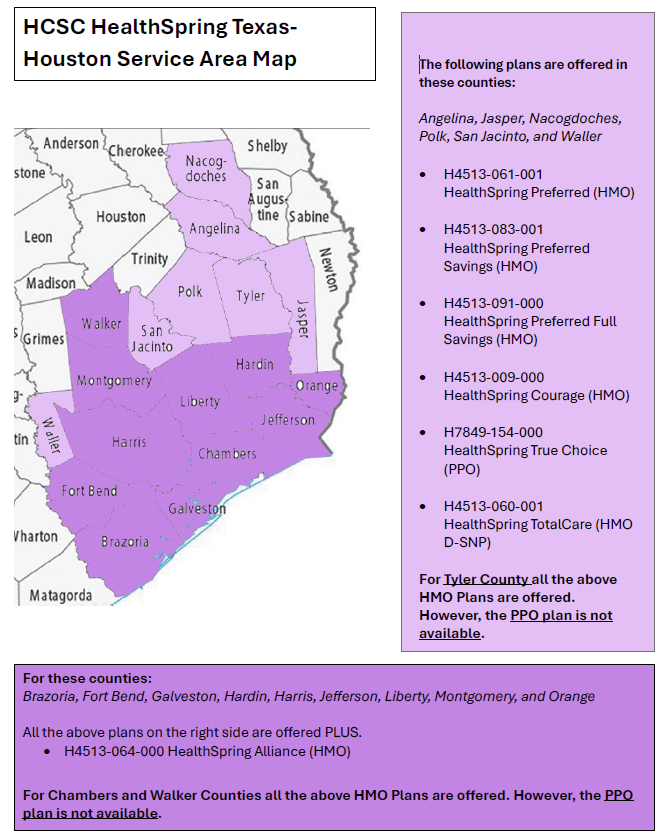
POET staff has done everything short of a full skeletal reconstruction to make the HealthSpring county page in the provider manual legible. They’ve stretched it. They’ve shrunk it. They’ve even converted it to Word and back to a PNG. It just didn’t have the backbone it needed.
If we were tibia honest, nothing worked.
So I, Sir Seymore Bones — resident WordPress writer and part-time osteo-optimizer — took pen in hand (metacarpals and all) to give everyone a little relief. When the formatting started rattling, I decided it was time to get to the bare bones of the issue.
I hope the map below helps you Sey-more, and make sense of the plans offered in our counties. We femur-ly believe this version is better. If it doesn’t… well, I promise I didn’t bone it up on purpose.



Recent Comments