

Tag: Staff Training
Virtual Coding and And Quality Symposium
A Better Communication… Conclusion
Medical practices increasingly face administrative burdens and staffing challenges that make truly patient-centered care difficult — if not impossible. But maintaining good patient relations pays dividends through higher patient satisfaction scores, increased loyalty and higher revenues during a time when margins are thin.
Secure, HIPAA-complaint asynchronous and synchronous communications can help the same number of staff to manage more patients, preserve provider time for the sickest patients and create workflow efficiencies.
Thank you to MGMA -Insight Article -3/21/22
A Better Communication Strategy Part 4
Patients shouldn’t need to take additional steps to communicate with the practice, such as download an app or remember log-in credentials for the patient portal. Mobile devices are convenient, handy and the preferred communications method for an increasingly tech-savvy population.
A communications platform that includes secure photo and video capabilities reduces significant barriers between patient needs and provider time.
Telehealth visits comprised a tiny portion of total medical visits prior to the pandemic. After skyrocketing by a factor of 78 during the early months of 2020, telehealth usage remains 38 times higher than the pre-COVID-19 baseline. Going forward, patients expect synchronous video to continue as a viable provider/patient communication avenue.
Asynchronous communication through text or photographs can increase patient touchpoints and satisfaction while making the practice more efficient. A dermatologist can look at a patient-submitted photo and determine whether a skin condition is harmless or warrants an in-person visit. A surgeon can look at a photo of an incision and determine whether it is healing properly.
Asynchronous communications can also help patients manage their chronic conditions. When integrated with the practice management system, personalized and templated messages can be sent to certain patient cohorts at pre-determined times. A cardiologist, for example, can request blood pressure readings for at-risk patients, or a general practitioner can request blood glucose numbers for diabetes patients. If the numbers look good, the provider can send a positive note that encourages future compliance, while negative numbers may require an appointment.
A Better Communication Strategy Part 3
A communications platform with HIPAA-compliant texting can create efficiencies within the practice in numerous ways besides appointment reminders, allowing staff to have one-to-many asynchronous conversations rather than one-on-one phone interactions. Staff members and providers in the practice or in practices within the same ecosystem can also have secure, asynchronous text conversations by simply @mentioning individuals or team, with those conversations becoming part of the patient record.
Practices can use smart routing to direct incoming messages to the correct clinical, billing or front-office department to ensure no patient slips through the cracks.
How often do practices receive calls about directions, parking or practice policies? Templated responses answered by text rather than phone free up staff time and increase the percentage of on-time patient arrivals. One physician using a HIPAA-compliant, text-based communications platform reports that his practice has never had a patient miss an appointment or arrive late.
Onboarding and front-end practices also can be accomplished by text. Having patients complete and send pre-appointment forms ahead of time can make the visit go more smoothly. Practices want a platform that can track communications, so that only those who haven’t filled out pre-appointment paperwork, for example, receive reminders.
A Better Communication Strategy Part 2
Small changes to practice workflows have been shown to affect overall organizational efficiency. The goal of a recent study was to support the Quadruple Aim of reducing costs while improving population health, patient satisfaction and the well-being of medical practice staff. By reducing administrative burdens, an intervention group could offer 48% more patient appointment slots than the control group.
Patient interactions must remain the focus of any practice contemplating workflow changes. At many practices, it’s already impossible to speak with a live person after negotiating a phone tree or sending an email through the patient portal. It’s imperative that any communications platform place patients front and center, with easy, secure and HIPAA-compliant interactions that don’t require the patient to download another mobile app.
Patient reminder calls waste staff time to make them and patient time to listen to them, return the call and/or ignore them. Instead, consider a personalized text message from the provider’s main phone line confirming the appointment. Studies show that 99% of text messages are opened — 97% within 15 minutes. The patient can quickly confirm the appointment or access the provider’s schedule to pick another time.
A Better Communication Strategy Part 1
A Little Dramatic, huh?
But how would you like to increase your practice efficiency through a better communication strategy?
Tune in each Tuesday for another little blurp.
Part 1. Patient satisfaction, loyalty can affect profits
The importance of effective communications between patients and provider cannot be overstated, as 91% of patients who were unhappy with their care experience reported they wouldn’t return to the practice or recommend it to others. Retaining happy patients is more cost effective than recruiting and onboarding new patients.
In a recent survey of health executives, 83% said improving patient access using digital tools is a top strategic priority, and 43% rated improving patient satisfaction as a strategic aim.
Happy patients start with competent staff who have the right tools to communicate effectively. However, when physicians were asked to name their top challenges for 2022, they overwhelmingly chose “administrative burdens,” which include staffing issues, prior authorizations and ever-present issues with EHRs.
Healthcare routinely ranks among the top industries for job departures, according to the U.S. Bureau of Labor Statistics. In December 2021 alone, nearly 90,000 healthcare workers left their jobs.
The continuing effects of the COVID-19 pandemic impact medical practices in myriad ways. Practices are still playing catch-up with patients who avoided visits during the initial pandemic shutdowns and who remain leery of in-person appointments.
The Power of the First Phone Call
“Patient satisfaction has become a key criterion by which to evaluate the
quality of healthcare services.
How make every call work for you.
The First Quarter 2022 issue of Cigna Network News is now available
Check out these pages:
4. Preventive Care Services Policy Updates
5. Reimbursement Policy Updates
7. Precert Updates (click here to view the Master Precert List)
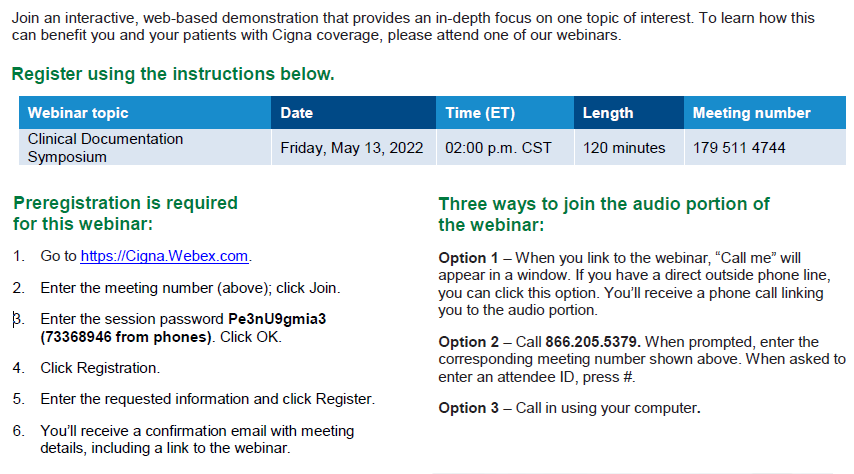
8. Webinar Schedule for staff training.
18. 2022 Cigna MA plan highlights (and card sample)
25. How to use Z Codes
34. How to contact Cigna
Coding and Billing Compliantly for APPs, MGMA
[embeddoc url=”https://community.poetllc.org/wp-content/uploads/2021/12/MGMA-2021-billing-for-APPs.pdf” download=”all” viewer=”google”]
Recent Comments