

Category: Medicare
Self-Pay Medicare Beneficiary
Protect Your Patient… Protect Your Practice… Protect Yourself
When a Medicare Beneficiary wants to pay out of pocket?
Check out these documents, located in POET InK files:
HSConnect Headache??
THERE IS RELIEF INSIGHT!!
To align with the recent extension of the federal public health emergency (PHE) period, Cigna is again extending the cost-share waiver for COVID-19 testing and testing-related services through April 20, 2021.
- Referrals requirements for in-network providers & out-of-network providers are waived through 04/20/2021.
- Providers do not have to go into HSConnect/MHK for referrals, but they will need to continue doing pre-certs for any services that require them.
- Specialists should accept members without a referral during this time. Referral requirements for in-network providers & out-of-network provider are waived through 04/20/2021.
For the most up to date information please go to https://medicareproviders.cigna.com/
MGMA Summary for 2020 Q4
And What to Look for in 2021 Q1
On Dec. 21, Congress passed massive year-end legislation that includes $1.4 trillion in funding for the federal government in FY 2021, an additional $900 billion in COVID-19 stimulus funds, and various other provisions that impact medical groups. President Trump signed the bill into law on Dec. 27.
In the coming weeks, MGMA expects the Administration will issue guidance on certain provisions of the new law. This guidance is expected to provide more detail into how these provisions will be implemented and the impact on medical groups. As this information becomes available, MGMA will keep medical group practices updated and will be revising resources, such as those published in MGMA’s COVID-19 Recovery Center.
Key provisions of the law include the following:
Medicare payment
- Increases Medicare payments across the board for CY 2021 from what was finalized in the 2021 Physician Fee Schedule (PFS) by adding $3 billion into the PFS and delaying payment of HCPCS add-on code G2211 for three years. MGMA expects that the Centers for Medicare & Medicaid Services (CMS) will release information regarding the updated payments for 2021 once it factors in the 3.75% increase to the PFS and calculates the impact of delaying G2211. We expect CMS to communicate the new conversion factor and new payment rates to local Medicare Administrative Contractors, who will update their schedules accordingly. These payment increases follow significant MGMA advocacy and will serve to offset cuts previously slated for Jan. 1, 2021.
- Temporarily suspends the 2% Medicare sequester from Jan. 1 through March 31, 2021. MGMA advocated for an extension of the current moratorium on Medicare sequestration authorized in the Coronavirus Aid, Relief, and Economic Security (CARES) Act.
- Extends the work geographic index floor under the Medicare program through Dec. 31, 2023.
- Expands access to mental health services furnished through telehealth past the expiration of the COVID-19 public health emergency. MGMA expects to see further guidance from CMS on this policy change.
Paycheck Protection Program (PPP)
- Extends and modifies the PPP to provide further flexibilities, such as:
- A simplified loan forgiveness application process for loans under $150,000;
- Clarification that loan recipients may deduct forgiven PPP loans;
- The creation of a “PPP second draw” loan for businesses that meet certain criteria;
- The allowance of additional eligible and forgivable covered expenses;
- The ability for certain 501(c)(6) organizations to qualify for a PPP loan; and
- The ability to elect a covered period ending between 8 and 24 weeks after loan origination.
- MGMA expects the U.S. Department of the Treasury to issue and update guidance to reflect the modifications made to the PPP in the coming days.
Provider Relief Fund (PRF)
- Adds $3 billion to the $175 billion PRF and clarifies how recipients can use funds to cover “lost revenue” attributable to COVID-19. The new law allows providers to calculate lost revenues using a budgeted-to-actual revenue comparison, rather than actual year-over-year comparisons as currently required by Department of Health & Human Services (HHS) guidance.
- This change, as well as the addition of funds, is welcome news; however, it remains to be seen how HHS will implement new clarification. Group practices should continue to monitor the PRF website for updates based on the new legislation in the coming days or weeks.
FFCRA paid sick and family leave
- Extends the refundable payroll tax credits for paid sick and family leave enacted in the Families First Coronavirus Reponses Act (FFCRA) through March 31, 2021, so employers may choose to continue offering paid leave to their employees. It does not, however, require employers to extend FFCRA paid sick and family leave past Dec. 31, 2020.
Surprise billing
- Provides patient protections from out-of-network medical bills. Nonparticipating providers at emergency facilities (or a participating provider at a nonparticipating emergency facility) will not be permitted to bill a patient beyond the allowed cost-sharing amount. Instead, the patient’s health plan will make an initial payment directly to the provider or issue a notice of denial. If the provider or plan is not satisfied with the payment, either party may initiate an Independent Dispute Resolution (IDR) process, which is overseen by a third party entity who has no affiliation with the provider or payer. Each party then submits a payment offer for consideration by the IDR entity, who selects one prevailing offer as the final payment amount.
- This provision is set to go into effect in 2022 and will involve rulemaking from the Administration to provide certain implementation details. Following MGMA advocacy, at the last minute lawmakers included improvements to the IDR process.
Alternative Payment Models (APMs)
- Freezes the 2020 qualifying participant thresholds required to achieve APM benefits, such as the 5% lump sum bonus. These thresholds were set to increase in 2021 to unrealistic levels, however pursuant to this legislation, will remain at the 2020 thresholds (at least 50% of Medicare Part B payments or at least 35% of Medicare patients through an advanced APM entity) through 2023. MGMA strongly supported maintaining 2020 thresholds in 2021 and beyond to allow more group practices to realize the benefits of APM participation.
MGMA 2021 Medicare Outlook
MGMA hosted their “2021 Medicare Update” yesterday Dec. 10th. That presentation has been recorded and is available for MGMA members on their website.
For your convenience the slide deck has been place in POET InK’s files. To view follow this path.
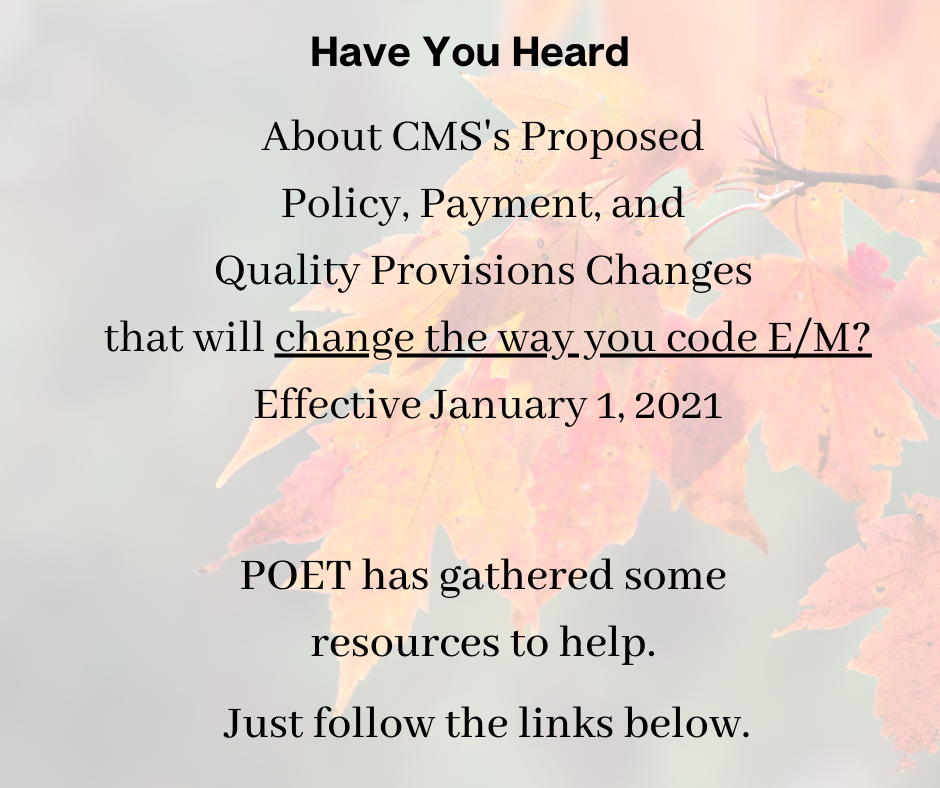
E/M Coding Changes are Coming. Effective 1/1/2021
Medicare Accelerated and Advance Payment Program (APP)
From: Drew Voytal
Associate Director
MGMA Government Affairs
Washington, DC
President Trump signed a continuing resolution appropriations bill into law that funds the federal government through December 11, 2020; section 2501 also includes several improvements to the Medicare Accelerated and Advance Payment Program (APP), including relaxing repayment terms. Upon request of a hospital or group practice that received accelerated or advance payments under Medicare Part A or Part B, CMS can:
- Delay recoupment of payments until one year from the issuance of the advanced payments;
- Once recoupment begins, apply a graduated recoupment schedule, where 25% of Medicare payments would be withheld during the first 11 months of recoupment, and 50% of Medicare payments would be withheld during the following six months; and
- Extend the period during which recipients must fully repay the advance payment amount in full to 29 months from the date of the first payment.
- The bill also lowers the interest rate on outstanding balances remaining after the 29-month repayment period from 10.25% to 4%.
CMS has not yet published information for groups wishing to avail themselves of these benefits, but we anticipate the agency will provide further information on how to make such a request. We will notify members once we see something.

Humana Support 10/1/2020
Information from Humana “September 2020 Provider Communication”
Did you know that we have Electronic Funds Transfer, or EFT, available for provider payments? EFT eliminates the need for paper checks. Payments will occur automatically, saving time, reducing mail, and giving you peace of mind. For information on how EFT works or to set up your account on EFT, please send an email to [email protected].
A schedule of upcoming web-based training sessions is also available in the BBS Documentation folder (under Simple Resources and tools>Training Opportunities). Sessions are created from the provider’s perspective and intended to meet the needs of new users as well as those in a more established organization.
Documentation and resource materials are available in the Service Fund Download section of Availity.com. For those with direct FTP access, this information is contained within each unique folder. Materials are located in the following sections under “Documentation”:
- Data File Layouts – Both current and updated layouts are included. Highlighted text indicates either a new or revised field.
- Humana Notices to Providers – A copy of this letter is available.
- Simple Resources and tools
-
- Training Opportunities – 2020 webinars
-
For questions regarding Service Fund or Service Fund processes, or to request Service Fund training, please send an email to [email protected]. Be sure to include identifiable information such as your provider or organization name, address, Humana ID number, etc.
Humana PPO (POET) Plan Breakout
Humana PPO Plans have National Network Reciprocity, allowing members to travel with the comfort of knowing they can use any Humana ChoiceCare PPO Network Provider across the county for in-network services.
From CMS MLN Connects
From CMS MLN Connects, two resources for telehealth see links below
Key take aways:
Question: Is any specialized equipment needed to furnish Medicare telehealth services under the new law?
Answer: Currently, CMS allows for use of telecommunications technology that have audio and video capabilities that are used for two-way, real-time interactive communication. For example, to the extent that many mobile computing devices have audio and video capabilities that may be used for two-way, real-time interactive communication they qualify as acceptable technology. The new waiver in Section 1135(b) of the Social Security Act explicitly allows the Secretary to authorize use of telephones that have audio and video capabilities for the furnishing of Medicare telehealth services during the COVID-19 PHE. In addition, effective immediately, the HHS Office for Civil Rights (OCR) will exercise enforcement discretion and waive penalties for HIPAA violations against health care providers that serve patients in good faith through everyday communications technologies, such as FaceTime or Skype, during the COVID-19 nationwide public health emergency.
Q: How does a qualified provider bill for telehealth services?
A: Medicare telehealth services are generally billed as if the service had been furnished in-person. For Medicare telehealth services, the claim should reflect the designated Place of Service (POS) code 02-Telehealth, to indicate the billed service was furnished as a professional telehealth service from a distant site.
Q: How much does Medicare pay for telehealth services?
A: Medicare pays the same amount for telehealth services as it would if the service were furnished in person. For services that have different rates in the office versus the facility (the site of service payment differential), Medicare uses the facility payment rate when services are furnished via telehealth.
Q: Are there beneficiary out of pocket costs for telehealth services?
A: The use of telehealth does not change the out of pocket costs for beneficiaries with Original Medicare. Beneficiaries are generally liable for their deductible and coinsurance; however, the HHS Office of Inspector General (OIG) is providing flexibility for healthcare providers to reduce or waive cost-sharing for telehealth visits paid by federal healthcare programs.
https://www.cms.gov/newsroom/fact-sheets/medicare-telemedicine-health-care-provider-fact-sheet
https://edit.cms.gov/files/document/medicare-telehealth-frequently-asked-questions-faqs-31720.pdf
From the Patient Side of Medicare
E-visits
Medicare Part B (Medical Insurance) covers E-visits with your doctors and certain other practitioners. Be sure to check the above link for the latest changes!!!
Your costs in Original Medicare
You pay 20% of the Medicare-approved
amount for your doctors’ services, and the Part B deductible applies.
What it is
E-visits allow you to talk to your doctor using an online
patient portal without going to the doctor’s office.
Practitioners who may furnish these services include:
- Doctors
- Nurse practitioners
- Physician assistants
- Licensed clinical social workers, in specific circumstances
- Clinical psychologists, in specific circumstances
- Therapists, in specific circumstances
| Note |
| E-visits can be used for the treatment of the Coronavirus (COVID-19) from anywhere. |
Recent Comments