CMS is changing the definition of HCPCS code G0136. They are keeping the code and the valuation of the code. The code is staying on the telehealth list. But there is a completely new definition.
Between now and 12/31/2025, G0136 is for an assessment of a patient in the areas of social determinants of health (SDoH). On 1/1/2025, G0136 is defined as the assessment of physical activity and nutrition.
New definition G0136“Administration of a standardized,evidence-based assessment of physical activity and nutrition, 5-15 minutes, not more often than every 6months.”
This service is not intended to be a screening for every patient. It is to be performed when there are known or suspected needs related to the patient’s physical activity level and nutrition.
The service is payable when both a physical activity and nutrition assessment are performed, “…or when either a physical activity or risk assessment is performed if there is a clinical scenario where only one is reasonable and necessary. For example, if a beneficiary has recently started a new diet but their physical activity levels have not been assessed, only a physical activity risk assessment may be reasonable and necessary.”
It can be billed at the same encounter as an E/M service, an annual wellness visit, 90791 psychiatric diagnostic evaluation, and health behavior assessment codes 96156, 96158, 96159, 96164, 96165, 96167, and 96168. What about 90792? The final rule does not list it as one of the base codes for G0136.
When performed on the day of an annual wellness visit, there is no patient due amount. When performed on the day of any of the other visits listed, it will be subject to the deductible and co-pay.
There is a frequency limit of once per six months per practitioner per beneficiary.
What’s required? In the definition, it says administration of a standardized evidence-based assessment. CMS is not requiring a specific assessment tool but gives examples of those tools. Those are listed below. Notice that it says 5 to 15 minutes. I would suggest documenting the time of the assessment, distinct from the other services. When time is listed in a CPT® or HCPCS code, document the time spent. I believe this assessment will be done by auxiliary staff, although how that is managed in the work flow when it is done after the practitioner assesses a need, I don’t know.
RHCs and FQHCs G0136 may be performed in an RHC or an FQHC, but will not result in additional reimbursement when performed on the same day as another service. It is not considered a qualifying visit in an FQHC, so if it is the only service performed on that date of service, there is no reimbursement for it.
“Examples of evidence-based tools to assess nutrition include, but are not limited to, the Mini-EAT tool, the Starting the Conversation: Diet tool, and Short Dietary Assessment Instruments. Examples of evidence-based tools to assess physical activity include, but are not limited to, the Physical Activity Vital Sign tool, the CHAMPS Physical Activity Questionnaire for Older Adults, and the Rapid Assessment of Physical Activity (RAPA) or Telephone Assessment of Physical Activity (TAPA).”
To reduce provider burden, certain contractor-priced HCPCS codes no longer require a paper invoices.
When the invoice information is entered in the narrative field on a claim for any of the HCPCS codes listed below, it is not necessary to provide the actual paper invoice for these services.
The required narrative information includes:
Invoice dollar amount and quantity for the drug or biological.
Name of the drug or biological administered.
The dosage of the medication or the size of the biological administered.
The route of administration if applicable.
Claims not containing information about the invoice or cost associated with the code(s) will reject as unprocessable.
Invoice amount
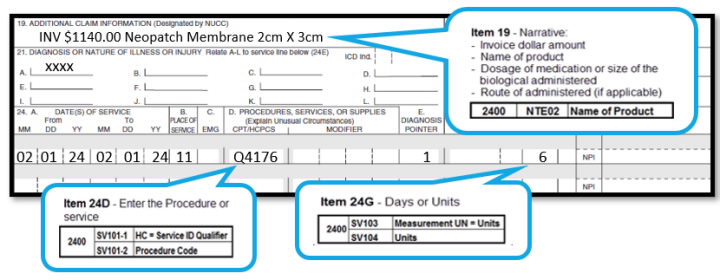
Enter the invoice amount in item 19 of the CMS-1500 paper claim form or the electronic equivalent using the following format (including cents):
Inv. $00.00 for list product name, description/size, quantity per invoice.
Claim example:
The provider administered 6 square centimeters of the biological represented by code Q4176 (Neopatch, or therion, per square centimeter), therefore procedure code Q4176 was billed with a quantity of “6”.
The invoice showed $1140.00 for Neopatch Membrane 2cm x 3cm:
The invoice amount is the total amount a provider pays for an item/service, taking into account ALL discounts, rebates, refunds, or other adjustments to an item. You must maintain sufficient documentation in the patient’s file in the event of a review.
The evaluation of codes for this list is an ongoing process. Be sure to check back frequently and subscribe to our mailing list.
POET has heard from Genesis our BCBS Network Management Consultant. 2024 HCPCs schedules are still in effect. The 1st quarter update will be effective March 1, 2025.
The 2025 Physician Fee Schedule proposed rule is a study in contrasts. If you’re the kind of person who can see both sides of an issue, this rule is for you.
Good News
Bad News
Practitioners doing telehealth from their home can continue to use the practice address instead of their home address on claims for 2025
Without an act of Congress, for real time audio/visual visits on 1/1/2025 patients can no longer receive these services in their homes in all geographic areas. Patients must be in an underserved area and go to a facility setting for telehealth. (Unless Congress changes this in their end of year Consolidated Appropriations Act.)
16 new telehealth codes that can be selected based on Medical Decision Making (MDM) or time.
Medicare has given them a status indicator of invalid.
New HCPCS code for GIDXX for visit complexity inherent to in patient and observation services associated with a confirmed or inspected infectious disease. (GIDXX is a placeholder code, not a final code.)
Limiting use. “We anticipate the HCPCS code GIDXX would be reported by physicians with special infectious disease training”
Can use G2211 when you use modifier 25 for an E/M and wellness visit on the same day, immunizations, and other preventive medicine services.
That’s the only exception.
This information is from Coding Intel and Betsy Nicoletti https://codingintel.com/
Ever thought about how a confident, well-trained front office team could transform your healthcare practice?
MGMA is thrilled to present the best front-office training in practice management, designed to improve patient interactions and boost your team’s performance. Make this a priority in your onboarding process today!
Make it a Priority.
Ed Plus is the easy-button on staff training, and it’s extremely cost-effective. Courses include:
It All Starts Here: Front Office Mastery
An Overview of Culturally Competent Care
Controlling Healthcare Workplace Violence
Dealing With Disruptive Patients
Diversity, Equity, and Inclusion in the Healthcare Workplace
Employment Law for Medical Practices
Establishing and Maintaining a Healthcare Compliance Program
Healthcare Common Procedure Coding System (HCPCS) modifiers FX and FY
Effective January 1, 2024, we will reduce payment for radiology procedures billed with modifiers FX and FY to align with the Centers for Medicare & Medicaid Services (CMS) guidelines.
• Modifier FX (X-ray taken using film): A 20% payment reduction applies to the technical component (and the technical component of the global fee).
• Modifier FY (computed radiography X-ray): A 10% payment reduction applies to the technical component (and the technical component of the global fee).
Reimbursement for code A9279
(monitoring feature/device)
Effective January 1, 2024, Aetna® will no longer reimburse for code A9279, since it is considered statutorily non-covered.


Recent Comments