Tag: Department of Insurance (DOI)
ERISA or maybe TPA?
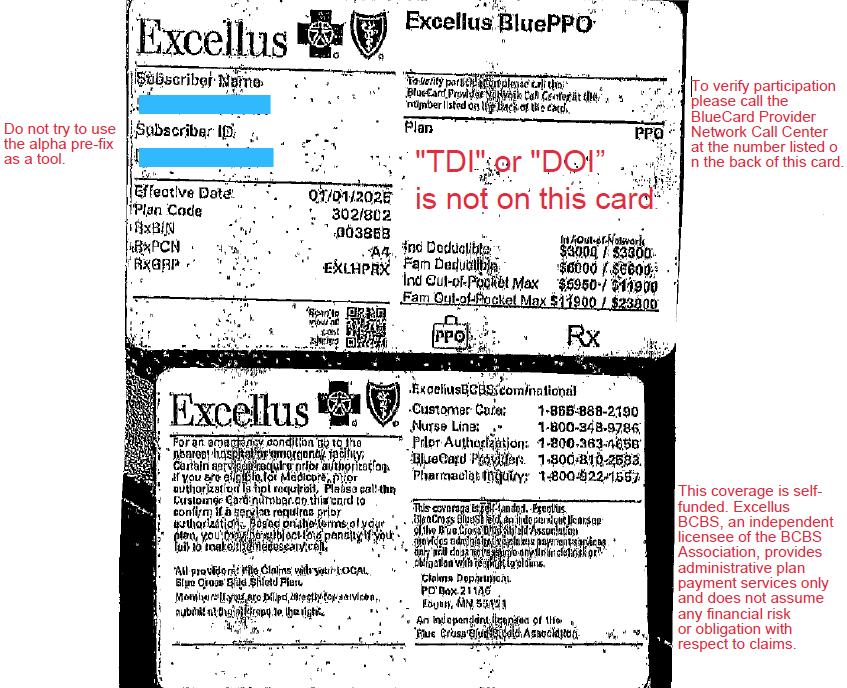
Let’s play pretend:
Some one gives you this card and wants to make an appointment.
They seem to want an answer right now.
You know your physician takes Blue Choice, but have never seen this card before. How would you know?
Look at the front of the card. Blue Cross is written all over it. BCBS must be the insurer? STOP!
Do you see any insurance regulation language? Is “TDI” or “DOI” on this card?
NO. This is your 1st clue. The employer may be the insurer.
Scan the front of the card intently. Are there any other clues. Look for what you know, not what you don’t know.
If not flip it over. What do you see? READ ALL THE TINY WRITING.
On this card: phone numbers, addresses, where to file, prior auth info. But what else?
“This coverage is self-funded Excellus BlueCross BlueShield, and independent licensee of the BlueCross BlueShield Association provides administrative claims payment services only and does not assume any financial risk or obligation with respect to claims.”
What does that mean:
- The employer is the insurer (self-funded plan)
- Excellus BCBS is acting as a Third-Party Administrator (TPA)
Is this a Lease Network?
Very likely — yes.
On the front of the card it says:
“To verify participation, please call the BlueCard Provider Network.”
That suggests:
- The plan is using the BlueCard network
- Excellus is providing network access + claims processing. The employer is leasing the BCBS network
That’s what we commonly call a lease network arrangement.
But — this is important — don’t assume, Verify
Why you may still get a “Yes” when you call
When you call provider services:
- The rep may simply see “In Network”
- They may not understand lease networks
- They may not understand the difference between:
- Payor
- TPA
- Repricer
- Network administrator
So we need to ask better questions.
Instead of just asking “Is Dr. Smith in network?”
Tell the representative you would like to check network participation.
Ask:
- Is this plan self-funded? (if it is self-funded it is not a lease network)
- Is Excellus the payor, or the administrator?
- Is this a leased network?
- Who bears the financial risk?
- Is Excellus repricing the claims?
- What network applies to this patient?
And always get:
✔ Representative name
✔ Date/time
✔ Call reference number
If the claim denies, that reference number becomes your leverage.
Why this matters
In lease network plans:
- The employer controls the benefits.
- The employer may carve out services.
- The employer may override network rules.
- The plan can be patient-specific.
Basically they can make up their own rules.
In practical terms — They have more flexibility than a fully insured DOI-regulated plan.
Protect Yourself when speaking to the patient.
Never speak in absolutes.
Use language like:
- “It looks like this is a self-funded plan…”
- “Based on the card wording…”
- “According to the representative I spoke with…”
- “At the time of verification…”
Never say:
- “Yes, you are definitely covered.”
- “This will pay.”
- “You are in network.”
ALERT: BCBS Not All PPO in the Suitcase Cards Follow the Rule
SAY IT ISN’T SO!
Things to look for: But remember cards are so tricky these days, what applies to one, may not apply for another:
Is the “Texas Department of Insurance” acronym TDI on the card? If a health insurance card does not have “TDI” on it, it is likely an ERISA plan, meaning it is a self-funded plan regulated by federal law and not by the Texas Department of Insurance (TDI) because the employer directly pays claims instead of relying on an insurance company; the absence of “TDI” indicates the plan is self-funded and therefore likely falls under ERISA regulations. (resource tdi.texas.gov)
Look for these phrases, usually on the back of the card:
“BCBS provides administrative services only and assumes no financial risk for claims.”
“JBS will utilize Anthem to handle member contract for Health plan administration”
“Anthem Blue Cross and Blue Shield provide administrative claims payment services only and does not assume any financial risk or obligation with respect to claims”
“BCBST provides administrative services only and assumes no financial risk for claims.”
2/11/25 Amended to add Cigna. Look for these terms on Cigna Commercial cards:
- Shared Administration (S)
- Benefits are not insured by Cigna or Affiliates
Scrutinize each member’s card on an individual patient basis. No rule is across the board.
Recent Comments